Introduction
When displaying results from FAMPAT or FULLPAT, Orbit Intelligence automatically selects one “main” patent authority in each family, so that a single publication is used as the representative member (for example to show the abstract or the claims).
This user setting is reused wherever a representative document is needed, including in exports and in any part of the interface that relies on a single “family representative”.
By default, Orbit Intelligence sets this parameter the first time you log in, using your browser language and region; for instance, a browser configured in EN-US will lead to a different configuration from JA-JP, where Japanese documents from the JP office, in Japanese, are prioritised.
You can later adjust this preference yourself in the user menu, in the “Display” section, where you choose which authority and language should be treated as your preferred family representative.
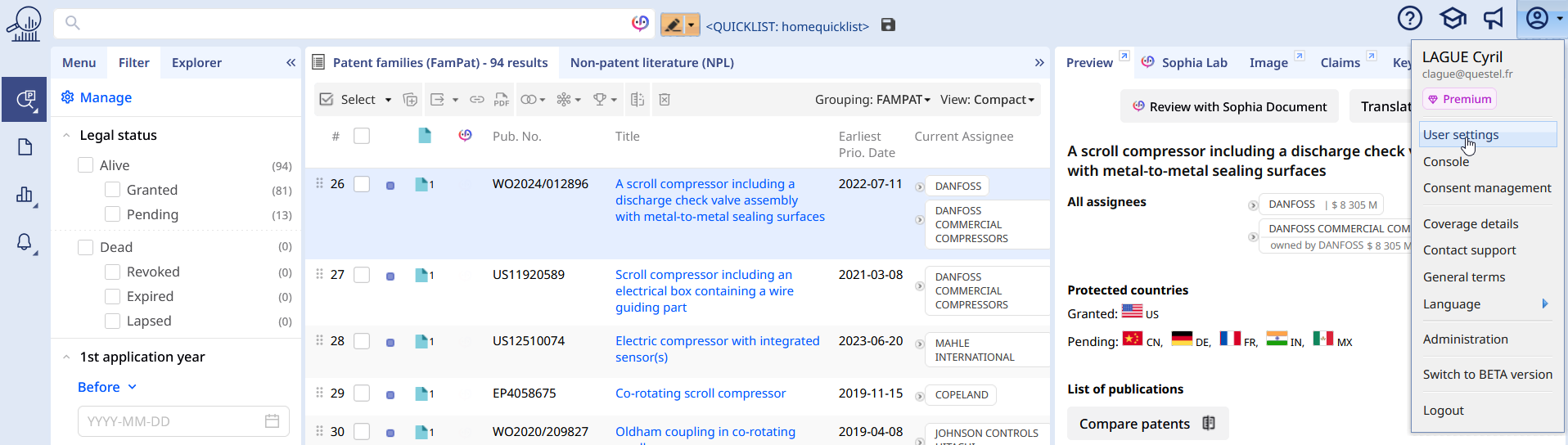
How to change ?
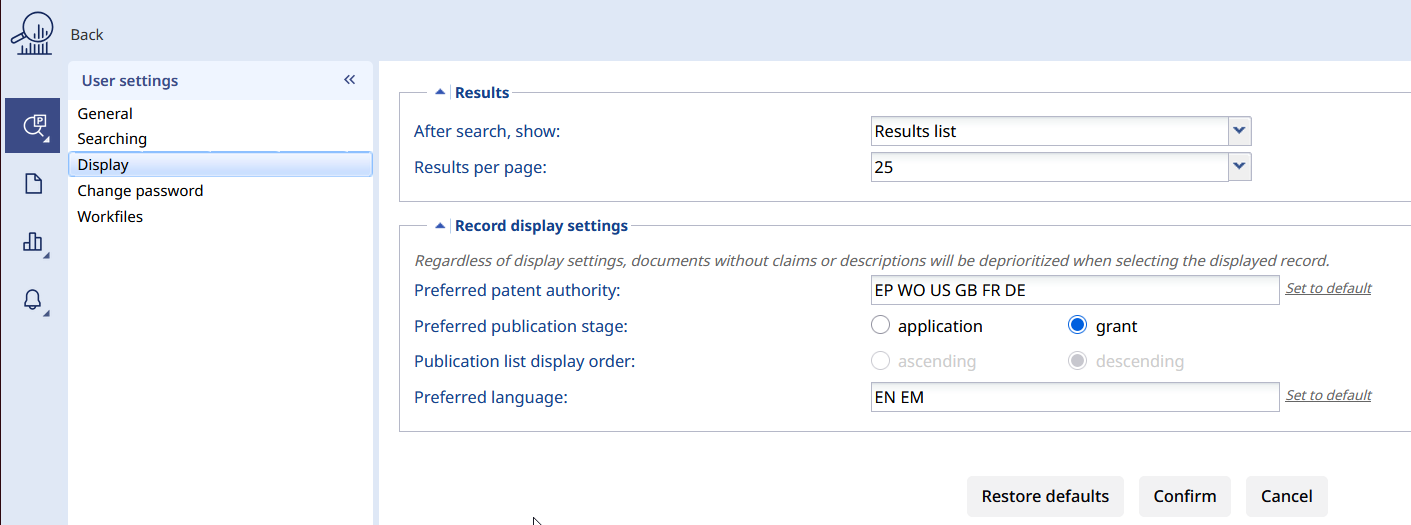
You must use the two letter country codes (ISO 3166-1) separated by a single space, and no punctuation (no coma or separation maker).
For instance with the configuration here below, Orbit Intelligence will try for every family, to display the EP member first (if any), then use the WO publication (if any) and so on...
As you may have several publication stage for the same application in a said authority, the second parameter "Preferred publication stage" will apply. By default, Orbit will try to use a granted stage, but you can change to the "published application" (the patent application content).
NB: the patent authority takes precedence over the publication stage, so if "Grant" is my preferred publication stage but the only granted patent in the family is a US one, alongside a pending EP application, Orbit will display the published EP application rather than the granted US patent.
One detail about Languages: The list of supported language codes is ISO 639. Among the most frequent language codes, here some examples such as EN EM FR DE JA ZH KO.
The code EM means "English machine translation", alongside the standard EN code for native English.
For many European users, because EP patents almost always include German and French abstracts, we recommend changing the default language setting to EN EM so that your hit list remains visually consistent and you avoid French or German records appearing in the middle of predominantly English results when EP documents are present, which can otherwise be confusing.
When the preferred stage has no content?
Orbit Intelligence will shunt and ignore some specific publication stages, as these publications stages do not have any content by design : WO A3, EP C or GBD0 (non-exhaustive list) .
De facto, even if the representative member of a family should be the latest EP granted stage (such as a EP C0), Orbit will ensure a fallback to the closest publication stage - here the EP B1 instead.
Some features like Sophia Document or Sophia Lab, rely on 1 publication stage to provide an answer for the family. This means you do not have to manually change to the latest publication stage with content.
Was this article helpful?
That’s Great!
Thank you for your feedback
Sorry! We couldn't be helpful
Thank you for your feedback
Feedback sent
We appreciate your effort and will try to fix the article