TABLE OF CONTENTS
- Introduction
- What are the differences between these document types?
- Why some Designs and Plant variety rights are also present in a patent database?
Introduction
In FAMPAT and FULLPAT, publications/documents might be categorised into 4 types :
- Patent applications, publications or granted patents
- Utility models
- Industrial Designs
- Plant variety rights
Questel's 50 years experience in data, allows to map corresponding country codes and related kind codes, to these 4 different types. A family could have several document types in the related field /DT.
Values for each type are stored such as following :
PATENT/DT
DESIGN/DT
UTILITYMODEL/DT
PLANT/DT
This new element is available in our Advanced Search form - if not visible, please customise the form to do so
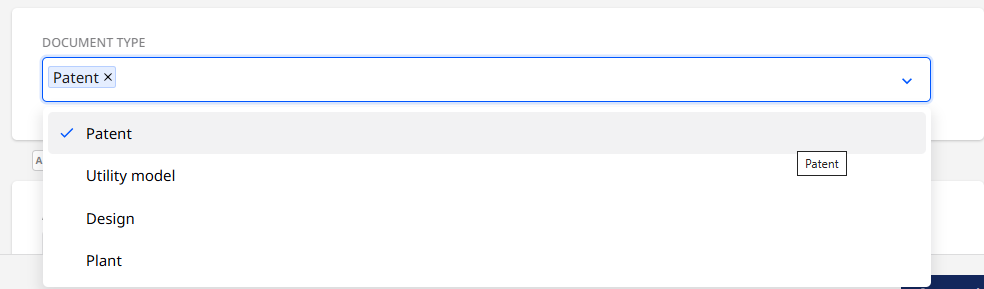
You can combine them like any keyword search in Command line:
(DESIGN OR UTILITYMODEL)/DT
(PATENT NOT UTILITYMODEL)/DT
This flexibility allows users to precisely filter results based on the type of IP protection they are researching.
What are the differences between these document types?
The document types described below may be unfamiliar to some users. The following definitions are intentionally high-level and are not meant to capture every legal nuance. Their primary purpose is to provide clarity and help users understand the core IP concepts involved.
Patent applications or granted patents,
- These documents relate to inventions that undergo examination by a patent office (either currently under examination or already examined). The rights granted by patents are primarily exclusionary in nature, meaning they provide the right to prevent others from making, using, or selling the protected invention.
Utility models,
- Utility models are generally published without substantive examination. They can be seen as a form of public disclosure, although in some jurisdictions they may later be reviewed by a patent office. If validated, utility models may grant enforceable rights to the owner, though typically for a shorter duration than patents.
Patent Designs:
- Patent design documents focus on the visual appearance of an article rather than its technical function. Indeed, there is no technical effect you can expect, from this shape/design. These documents usually include drawings and minimal text - describing the object with few words. Patent offices examine designs primarily for novelty, and once granted, they provide rights related to the use and commercialisation of the protected design.
Plant variety rights:
- Plant variety rights are intended to certify the creator of a new plant variety. These rights protect new vegetal breeds and grant the holder specific commercial rights related to their propagation and distribution. More details about this element here.
Why some Designs and Plant variety rights are also present in a patent database?
Questel maintains a worldwide patent database built from more than 100 data sources, with patent offices serving as the primary providers.
When a patent office includes design rights or plant variety rights in its official data feeds, Questel processes this information using the same high-quality standards applied to patent data. This includes number formatting, date standardisation, assignee normalisation, and text processing.
Because designs and plant variety rights have their own distinct kind codes, they do not interfere with standard patent data. Instead, they coexist alongside patent documents, allowing users to access a broader and more comprehensive view of IP information.
Questel is pleased to make this data available to all Orbit Intelligence users, further enhancing global IP transparency and research capabilities.
Was this article helpful?
That’s Great!
Thank you for your feedback
Sorry! We couldn't be helpful
Thank you for your feedback
Feedback sent
We appreciate your effort and will try to fix the article